


Moving to Cyprus from UK in 2026? The first real question is which residence route actually fits your situation. Employment, investment, and remote-income permits all follow different legal and financial rules. Permanent residence permit is available through defined investment paths starting from €300,000, while other permits depend on the income source and structure.
At the same time, the environment is shifting. Tax rules are being updated, Cyprus is moving closer to Schengen, and housing expenses remain a key planning factor. Feels fragmented and hard to align? This guide lays out every option clearly so you can plan with confidence.
Relocating to Cyprus from the UK: What Changed After Brexit
Brexit flipped one big switch: UK citizens lost the free movement available to EU citizens. Cyprus now treats most UK arrivals as third-country nationals, which means the right to live in Cyprus is no longer automatic.
The 90-day Limit Is the New Default
If you’re visiting Cyprus, you can stay up to 90 days in any 180-day period. Overstays can cause issues on exit and affect future entry.
Key nuance people miss: Cyprus is not in Schengen, so Schengen time and Cyprus time are counted separately. You can spend 90/180 days in Schengen countries and still have a separate 90/180 allowance for Cyprus (and vice versa). If you want more than 90 days in Cyprus, you move from “visitor” to residency planning.
High-level Permit Pathways (What “Long-stay” Usually Means)
So, if you want to stay in Cyprus for more than 90 days, you need a legal basis to do so. UK movers typically land in one of these buckets:
- Employment route (job and work authorisation/legal residence basis).
- Visitor/long-stay residency as a third-country national (for people staying beyond 90 days without local employment).
- Investment-based permanent residency (Regulation 6(2)): A well-known PR track (also referenced as a Cyprus Golden visa) tied to a qualifying investment, commonly referenced at around €300,000+ in eligible categories.
- Digital nomad-style residency allows you to live in Cyprus while working remotely for a foreign employer or clients abroad, without entering the local job market. Your income must come from outside Cyprus.
Common Mistakes UK Movers Make
There are several common, widely spoken mistakes UK citizens make when relocating to Сyprus. Here are the main ones:
- Assuming the old European Union-style flexibility still applies. It does not; 90/180 is enforced as the baseline.
- Mixing up Schengen math with Cyprus math. Your Schengen days do not “use up” Cyprus days, and the reverse is also true.
- Entering as a visitor while already planning to work remotely or stay most of the year.
- Starting residency paperwork too late and discovering that key documents must be issued before arrival.
- Underestimating how long approvals take and planning moves around optimistic timelines.
90 Days vs Residency & Key Documents
To avoid these mistakes and keep everything legally sound, you need a clear set of documents that are best prepared in advance. Below is the full checklist for different cases.
If You Stay up to 90 days (Conference, Travel, Short Business, Holiday)
In this case, you enter Cyprus as a visitor. However, you should still have the following documents available before you leave:
- Valid UK passport (issued less than 10 years ago, valid at least 3 months after exit)
- Return or onward ticket
- Proof of accommodation (hotel booking or invitation letter)
- Travel medical insurance covering the full stay
- Proof of sufficient funds (recent bank statement or bank cards)
If You Plan to Stay More than 90 Days (Residency Required)
Below is a checklist, structured by timing. The exact set may vary depending on your reasons to move to Cyprus (work visa, study, investment, remote income, family reunion visas), but the base requirements are largely the same. However, consider verifying requirements with official sources and/or a qualified professional for the chosen route.
These documents should be prepared before arrival, as some are difficult or slow to obtain later:
- Valid passport + copies of all used pages
- Birth certificate (often requested for long-term or family-related files)
- Marriage certificate (if applying as a couple or family)
- UK criminal record certificate (ACRO Police Certificate)
- Proof of income: employment contract/pension statements/investment income evidence
- Recent bank statements
- Private health insurance meeting Cypriot requirements
- Proof of accommodation in Cyprus: rental agreement registered with the Tax Department/property ownership documents
- Passport-size photos
- Official translations into English or Greek if originals are not in English
If applicable:
- Employment offer or contract (work-based residence)
- Cyprus university acceptance letter (study-based residence)
- Investment agreements or title deeds (investment-based residence)
- Proof of remote work with foreign employers or clients from non-EU countries (digital nomad-style residence)
These steps should be handled after arrival (typically within the first week):
- Secure a long-term address (if not arranged in advance).
- Register the rental agreement with the Cyprus Tax Department (Form IR 163 may be required).
- Obtain a local phone number from Cypriot providers such as Cyta, Epic, or PrimeTel.
- Open a Cypriot bank account (commonly with Bank of Cyprus, Hellenic Bank, Alpha Bank, or Eurobank).
- Finalise private health insurance accepted for residence permit applications.
The following steps are typically started within the first 30 days after arrival and completed before your visitor permission expires, depending on the permit category:
- Submit the residence permit application to the Civil Registry and Migration Department.
- File the application at the local District Migration Office based on your address.
- Provide biometrics (fingerprints and photo). Taken on site at the Migration Office during or after submission.
- Obtain an Alien Registration Certificate (ARC) issued by the Migration Office. This is your personal ID number in Cyprus, used for banks, tax, utilities, and official services.
- Register with the Cyprus Tax Department if required. Done through the District Tax Office or online if you work, earn income, become a resident, ready to pay income tax.
- If working or studying: complete employer or university registrations. Handled by your employer (work) or educational institution (study).
We’ve grouped common documents people are typically asked for into one clear table to make the process easier to follow:
| Before You Leave | First Week in Cyprus | First Month in Cyprus |
| Valid passport | Long-term address | Residence permit application |
| Copies of all used passport pages | Registered rental agreement | District Migration Office filing |
| Birth certificate | Local phone number | Biometrics (fingerprints & photo) |
| Marriage certificate (if applicable) | Cypriot bank account | Alien Registration Certificate (ARC) |
| UK criminal record certificate (ACRO) | Tax Department registration (if required) | |
| Proof of income | Employer registration (if working) | |
| Bank statements | University registration (if studying) | |
| Private health insurance | ||
| Proof of accommodation | ||
| Passport-size photos | ||
| Official translations (if required) | ||
| Employment contract (if applicable) | ||
| University acceptance letter (if applicable) | ||
| Investment documents (if applicable) | ||
| Proof of remote work (if applicable) |
Cost of Relocating to Cyprus
Here’s a clear by-bucket cost breakdown for moving to Cyprus from UK after Brexit. We offer approximate but realistic ranges and what drives them.
1. Removals/Shipping
The cost of shipping your belongings to Cyprus naturally varies depending on how much you’re moving, as well as a few other factors such as the origin city (London vs regional pickup), destination city (Limassol usually costs more than smaller towns), packing level (self-pack vs full-pack), stairs or lifts, storage, customs handling, and seasonality, with summer being the most expensive. Depending on volume, you usually end up with three options, which also means three rough price ranges.
Shipping a Few Boxes (Courier/Luggage Shipping)
Best when you’re moving light (clothes, small items, no furniture).
- Small parcels can start around £11–£13 on budget services.
- For heavier boxes, you’re usually in triple digits fast: e.g., ~£110–£150 for 20kg, ~£230–£280 for 50kg as a typical range.
- “SendMyBag”-style luggage shipping often starts around $129 (varies a lot by size/route).
Shared Container (Groupage/LCL)
Best when you have “more than boxes, less than a full household.” Shared container prices to Cyprus from the UK are commonly quoted from ~£996, depending on provider and service level.
Full container (FCL: 20ft vs 40ft)
Best when you’re moving furniture or a full home. You’ll see very different “typical” numbers depending on what’s included (just sea freight vs full removals service). For UK → Cyprus:
- 20ft container: ~£1,435
- 40ft container: ~£2,175
2. Flights + temporary accommodation
Flight prices swing hard by season. Budget data shows January is often the cheapest month on this route (most flights £33-£95). Meanwhile, July/August are among the most expensive, with much higher average return costs.
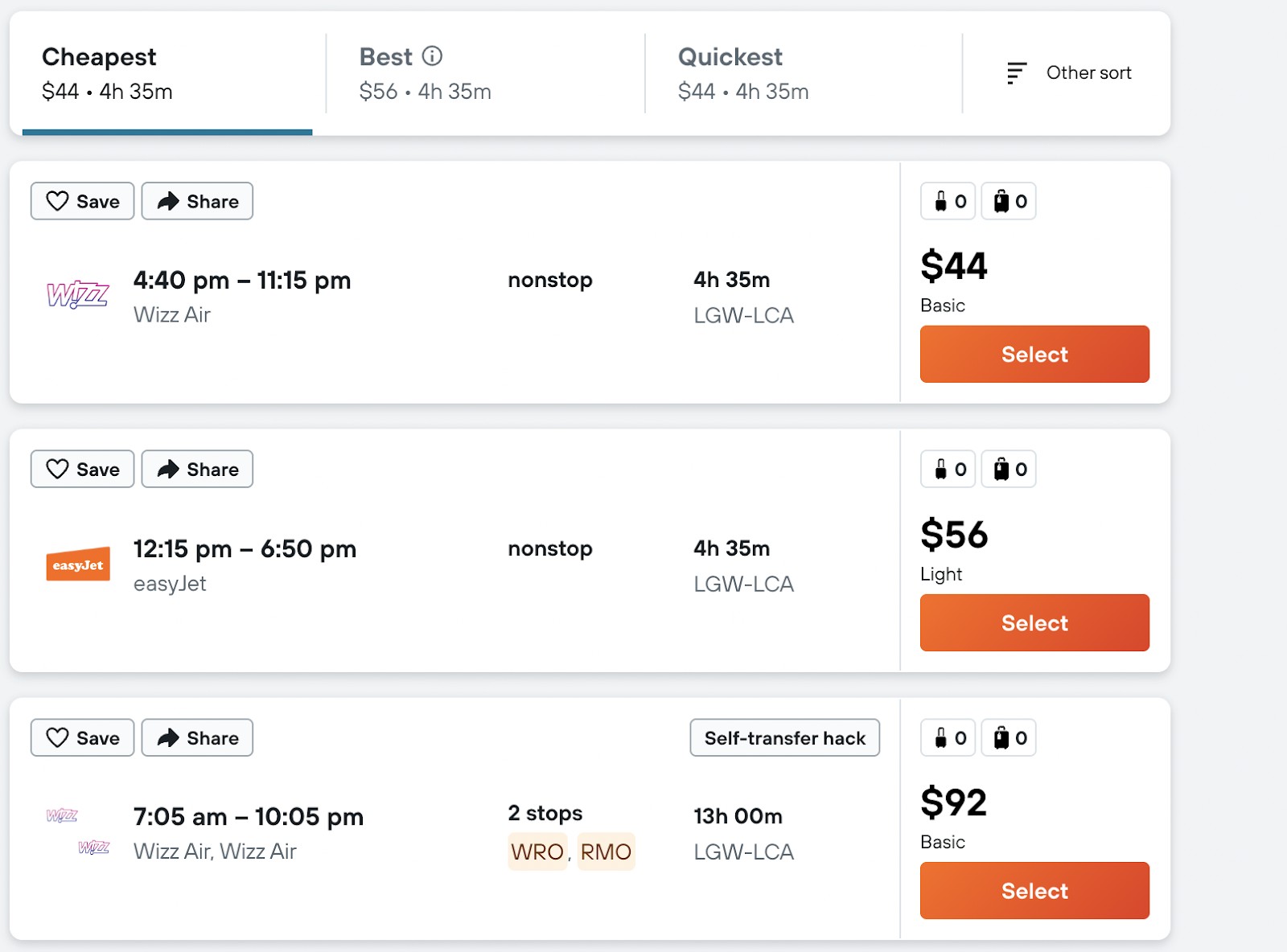
If you’re landing first and then finding a rental, your “bridge” cost is usually your biggest surprise after shipping. Example market benchmarks for Limassol:
- Average 4-star hotel pricing around ~£138/night (and higher for 5-star).
- Some hotels show a monthly typical rate of ~€86/night for a specific property versus a city average of ~€149/night in recent pricing snapshots.
3. Deposits (rent + utilities)
Most long-term rentals typically ask for 1–2 months’ rent as a deposit, plus the first month upfront is common. Plus, for domestic electricity deposits (EAC), the official table shows: Tenants from non-EU nationals who do not own the property are required to pay a €350 deposit, which is the bucket most UK renters fall into. For comparison, tenants from other European countries who do not own the property pay a €200 deposit, while property owners pay €75.
4. Admin costs (translations/certifications/fees)
On the UK side, an ACRO Criminal Records Office Police Certificate costs £65 on the standard service or £115 if you want to receive it within two days. If your UK documents need an apostille, that’s usually another £40 charged by the Foreign, Commonwealth & Development Office, plus whatever the service provider adds for handling and delivery.
Then come the Cyprus-side costs. The Press and Information Office (PIO) charges about €22 per 250 words for certified translation, including certification, based on published rates for documents of that length. Private services in Cyprus often charge around €35–€80 per page (roughly 250–300 words).
Extra copies and urgent handling can add small fees on top of the base rate. However, since Cyprus abolished stamp duty starting January 2026, you don’t need to factor a separate €2 stamp duty on new translations or documents completed after that date.
Migration/residence-related fees depend on permit type, whether it’s a temporary residence permit (“pink slip”), work, study, or getting Cyprus permanent residency through investment. expect application and card fees in the tens to a few hundred euros per person, on top of document preparation costs such as translations, certifications, and photos.
5. Buffer fund
A buffer fund keeps you calm when things don’t go exactly to plan. It covers the gaps, like a delayed shipment, an extra month in temporary accommodation, a landlord asking for a two-month deposit, or a bank account setup that drags on longer than expected. A realistic buffer is usually:
- Minimum: 1 month of living expenses + 1 month of rent.
- Better: 2–3 months of rent/living on mediterranean island costs if you’re not on a fixed employer package.
Where to Live After Moving to Cyprus
Choosing where to live in Cyprus is rarely fast or effortless. That’s exactly why many people moving here after Brexit start researching cities and neighbourhoods well before they actually relocate. The better prepared you are, the fewer compromises you’ll have to make later. Most newcomers focus on four locations:
Limassol is the most international city in Cyprus and the main hub for Cyprus companies. It offers strong job opportunities, modern residential buildings, and an active social scene. On the downside, it’s the most expensive rental market on the island, and competition for good apartments in Limassol is high. It’s popular with professionals, families, and investors.
Districts:
- Germasogeia: Large expat community, close to the sea, many modern apartments.
- Mesa Geitonia: More local, good access to highways, slightly lower rents.
- Agios Tychonas: Upscale, quieter, villas and sea views.
- City centre: Walkable, lively, older buildings mixed with renovations.
Nicosia is the capital and the centre of government and office life. It’s built around stable routines, shorter commutes, and year-round city living rather than a coastal lifestyle. Rental prices here are usually more predictable, especially when compared to coastal markets where pricing is influenced by premium property segments of Cyprus luxury villas. The trade-off: no sea and far less of a resort feel.
Districts:
- Engomi: International area, embassies, universities, family-friendly.
- Strovolos: Residential, good for long-term living, solid infrastructure.
- City centre: Cafes, offices, older apartments, active weekday life.
Larnaca, south Cyprus, is often seen as a balanced option. It’s close to the main international airport, more relaxed than Limassol, and usually more affordable. The city works well for people who want coastal living without constant pressure on prices. It’s quieter, which some love and others find limiting.
Districts:
- Finikoudes/city centre: Promenade, cafes, nightlife, close to the harbour.
- Mackenzie: Beach area, restaurants, popular for short- and long-term rentals.
- Aradippou: More residential, better value, short drive to the centre.
Paphos is known for its slower pace and lifestyle focus. It attracts retirees, long-term expats, and remote workers. Rental demand is less intense, but job opportunities are limited. It’s ideal if the work location is flexible and quality of life comes first.
Districts:
- Kato Paphos: Tourist area, sea access, lively in season.
- Universal: Popular with British expats, newer developments, and a central location.
- Chloraka: Quieter, residential, good value for space.
Once you know the city, neighbourhoods, and your key criteria, it’s time to start viewings. Most people either work with a local real estate agent or browse listings themselves. Common platforms used in Cyprus are Bazaraki, Facebook Marketplace & local expat groups, developers’ websites.
Finally, don’t forget that the security deposit is most commonly 1–2 months’ rent, plus the first month paid upfront. In hot markets or for high-demand properties, landlords may push for more, but 1–2 months is the normal baseline. Also, keep in mind the electricity deposit (EAC) mentioned earlier, which is a separate upfront cost.
How to Avoid Rental Scams: Simple Rules that Save You Money
- If someone pressures you to send a deposit immediately to “secure it,” treat that as a red flag.
- Always view first (or have a trusted person view), then sign, then pay.
- Pay only against a written agreement (even if it’s a simple one-page lease).
- Get a receipt for every payment (deposit, rent, agency fee).
- Match names: the person taking money should be the landlord or a clearly identified, authorised agent.
Admin Setup in the First Weeks After Moving
To actually make daily life work in the first weeks after moving from UK to Cyprus, you’ll need to handle a few practical admin steps on top of housing and residency. These are the things that unblock everything else, from banking to the internet to basic services.
Local SIM card and Internet
You’ll need a Cypriot number for banks, utilities, deliveries, and appointments. The main mobile providers in Cyprus are:
- Cyta
- Epic
- PrimeTel
Getting a prepaid SIM is straightforward and usually only requires a passport or a valid ID. Monthly plans typically start at around €15–€25 for basic data and calls, while unlimited or high-data plans are more often in the €30–€40 range. SIM cards are easy to buy in official operator stores, shopping malls, or on major shopping streets, and registration is usually completed on the spot.
For home internet, the same major providers are typically available, along with Cablenet. Basic DSL or entry-level fibre plans usually cost around €30–€40 per month, while higher-speed fibre packages are more often in the €45–€60 range. Installation is rarely instant and often takes 1 to 3 weeks, especially if fibre hasn’t already been activated in the building.
Bank Account or Fintech Setup
Of course, after moving to Cyprus from UK, you’ll need a local account for rent, utilities, salary, or residency-related payments. The bank people usually start with:
- Bank of Cyprus
- Hellenic Bank
- Alpha Bank
- Eurobank Cyprus
Banks in Cyprus usually ask for a passport, proof of a local address such as a rental agreement, an ARC number or a residence application receipt, and some form of income proof like an employment contract, payslips, or bank statements.
The process can take anywhere from a few days to a few weeks, depending on how complete your documents are and how quickly you can get an appointment. Because of this, many people rely on fintech services like Revolut or Wise as a practical stopgap while their local bank account is being set up.
Proof of Address
It is often one of the biggest bottlenecks. This is the document banks, utilities, and other services use to confirm that you actually live at a specific address in Cyprus. Without this document, you may get stuck with banking, internet, and some registrations. In most cases, banks accept:
- Registered rental agreement
- Utility bill in your name (once utilities are set up)
- Bank letter confirming address (after account opening)
Registering with Local Services (depends on your status)
Depending on why you consider moving to Cyprus after Brexit, you may also need to register with:
- Tax Department (if working, invoicing, or becoming a tax resident)
- Employer registrations (handled by the employer for employees)
- University administration (student visa)
- Social insurance (for employment-based residence)
- Local municipality (in some districts)
These steps often require documents from earlier stages, which is why order matters.
The Main Bottleneck to Be Ready For
Most delays don’t come from complicated Cyprus immigration rules, but from the way everyday processes depend on each other and move at their own pace. This is what usually slows people down the most in the first weeks:
- Document dependencies: One step often can’t move forward until you receive paperwork from the previous one, which creates small but very real delays.
- Appointment lead times: Banks, migration offices, and utility providers often work by appointment, and available slots are not always immediate.
Because of this, the first weeks after moving to Cyprus from the UK often feel slower than expected, even when everything is clear and technically straightforward.
Healthcare and Insurance in Cyprus
Cyprus’ public healthcare system is the General Health System, usually called GHS or GeSY. To use it, you have to be enrolled as a beneficiary and linked to a personal doctor. Eligibility is tied to being ordinarily resident in the Cypriot government-controlled areas and fitting a beneficiary category (like working in Cyprus or holding certain residence statuses).
Temporary stay (up to 90 days)
If you’re coming for a temporary stay under the 90-day visitor window, you plan around travel-style healthcare, meaning you bring your own cover. That usually means travel medical insurance, because you are not setting up long-term access to the local system.
Long-term Stay without Employment (Private Cover First)
If you’re staying longer and want to obtain permanent residency as a UK national (so, third-country status post-Brexit), expect that private medical insurance is part of the early paperwork for many residency routes, especially the “temporary residence” visitor-style permit called a Pink Slip. Cyprus wants to see that you have medical cover while your residence situation is being processed and before you’re in the local contribution-based system.
Employment-based Residence
If you’ll be employed in Cyprus, the planning is easier: your access to GeSY usually becomes realistic once your employment and contributions are in place, and you can enrol through the GeSY process. That is why people who arrive with a Cyprus job lined up typically rely less on long-term private insurance and more on bridging cover for the first gap.
Retirees and the S1 route
If you’re retiring from the UK and receiving a UK State Pension (or you otherwise qualify for UK-funded cover abroad), the key document is the S1. Once you have an S1, you register it in Cyprus, and that’s what gives you access to healthcare on a local basis for you and your dependents.
Residents without Cyprus Employment
If you’re a resident in Cyprus but not working locally (for example, living on savings or foreign income), you rely on private insurance initially (often required for the residence file), and then you reassess once your residency status and eligibility category for GeSY are clear. The eligibility hinges on the specific category you fall into and the documentation you can provide.
Driving, Transport, and Car Import
For drivers moving to Cyprus from the UK, there’s one extra bureaucratic layer to plan for before you can fully settle in: getting your right to drive recognised locally, and making sure any car you use is properly registered and insured.
Driving Licence Rules
You can drive in Cyprus on a UK licence, but once you become resident, you’re expected to exchange it within 6 months. The exchange is done through the Road Transport Department/Citizen Service Centres and typically costs about €40-€45 (for those under 65).
Buying a Car vs Importing
Importing from the UK is where costs jump. If the car does not qualify as UK-origin (or you can’t prove origin), a common baseline is 10% import duty + 19% VAT (VAT calculated on value + duty). Typical shipping is ~€900–€1,300, plus clearing agent fees often ~€120–€400. Because of that, many movers buy locally instead.
Insurance and Budget Impact
Insurance is mandatory, and pricing depends on licence type, residency status, driving history, and vehicle value (typically, €300-€1,200+ per year). Transport choices change your total budget fast: importing adds tax, shipping, and admin, while buying locally moves spend into purchase price, insurance, and road tax (often €200–€500+ per year).
Relocating to Cyprus from Other Countries: US & Canada
Below is a clear comparison table showing how relocation from the US and Canada works in practice, especially the gap between tourist entry and long-term living.
| Topic | Moving to Cyprus from US | Moving from Canada to Cyprus |
| Tourist entry | Visa-free entry for up to 90 days in any 180-day period | |
| Residence permits | Treated as third-country nationals, same permits as UK (work, visitor, investment, remote income) | |
| Non-working residence | Proof of stable foreign income + private health insurance expected | |
| Remote income reality | Remote work is tolerated under the correct residence status | |
| Employment route | Requires Cyprus employer sponsorship and a work permit | |
| Healthcare access | Private insurance needed initially; public system later if eligible | |
| Tax awareness | US citizens must consider worldwide tax obligations | Canadian residents must manage tax residency exit carefully |
For both US and Canadian citizens, Cyprus is easy to enter, but not easy to stay in long-term without planning. Tourist entry for foreign nationals is short-term by design. If your intention is to live in Cyprus, residency planning must start early, before the 90-day window runs out.
Relocating to Cyprus from the UK, in a Nutshell
Moving to Cyprus from UK in 2026 is a sequence of choices you need to align early: your residence/Cyprus citizenship route, your paperwork timeline, and your budget. For UK citizens relocating to Cyprus after Brexit, the 90-day rule is the baseline, and anything longer requires a clear legal basis, prepared documents, and realistic lead times for approvals and appointments.
The cost of moving to Cyprus adds up fast through shipping, deposits, admin fees, and the first-month setup, so planning needs a buffer, not optimism. Housing is rarely quick, which is why many people relocating to Cyprus start the city and district shortlist before they arrive. If you treat relocation like a staged process instead of a one-off move, Cyprus becomes predictable, manageable, and much cheaper to get right the first time.


